0
0,00 € 0 items

No products in the basket.

Boccia · Rules of the game

Boccia rules.
Easy to learn.

One white jack, six red balls, six blue balls. The aim: get your balls closer to the jack than your opponent’s.
Simplified rules to start playing today, then the essentials of the international rules: court, ends, scoring, classes, equipment and faults.
Simplified rules

Start playing now.
In six steps.

Boccia is a seated precision sport, close to bowls and pétanque. A Paralympic sport since 1984, it is played for fun as well as in competition. For your first game, these rules are all you need.
01

Two sides

One side plays the 6 red balls, the other the 6 blue balls. Each side has 1, 2 or 3 players, who share its balls.
02

A court that fits your space

Use the space you have: 3 × 5 m is enough to start. Mark a throwing line with tape and line the players up side by side behind it.
03

The jack

The red side throws the jack, the white ball, then its first red ball, as close to the jack as possible.
04

The reply

The blue side throws its first blue ball, with the same aim: get as close to the jack as possible.
05

Furthest plays again

The side whose best ball is furthest from the jack plays again, until every ball has been thrown. If the jack is knocked out, it goes back on the cross in the middle of the court.
06

Count the score

1 point for each ball closer than the opponent’s best ball. In the next end, the other side throws the jack. A match is played over 4 ends.
Variant

Faster: take turns

To speed up the game, the sides throw in turn: red, blue, red, blue, whichever ball is closest.
Tip

Everyone seated: a fairer game

With able-bodied players and wheelchair users together, agree at the start that everyone plays seated. Everyone then plays on equal terms.
The official court

12.5 metres.
Not one more.

A flat, smooth and clean floor: wood, polished concrete or synthetic surface. Lines are marked with tape and always measured from the inside edge.
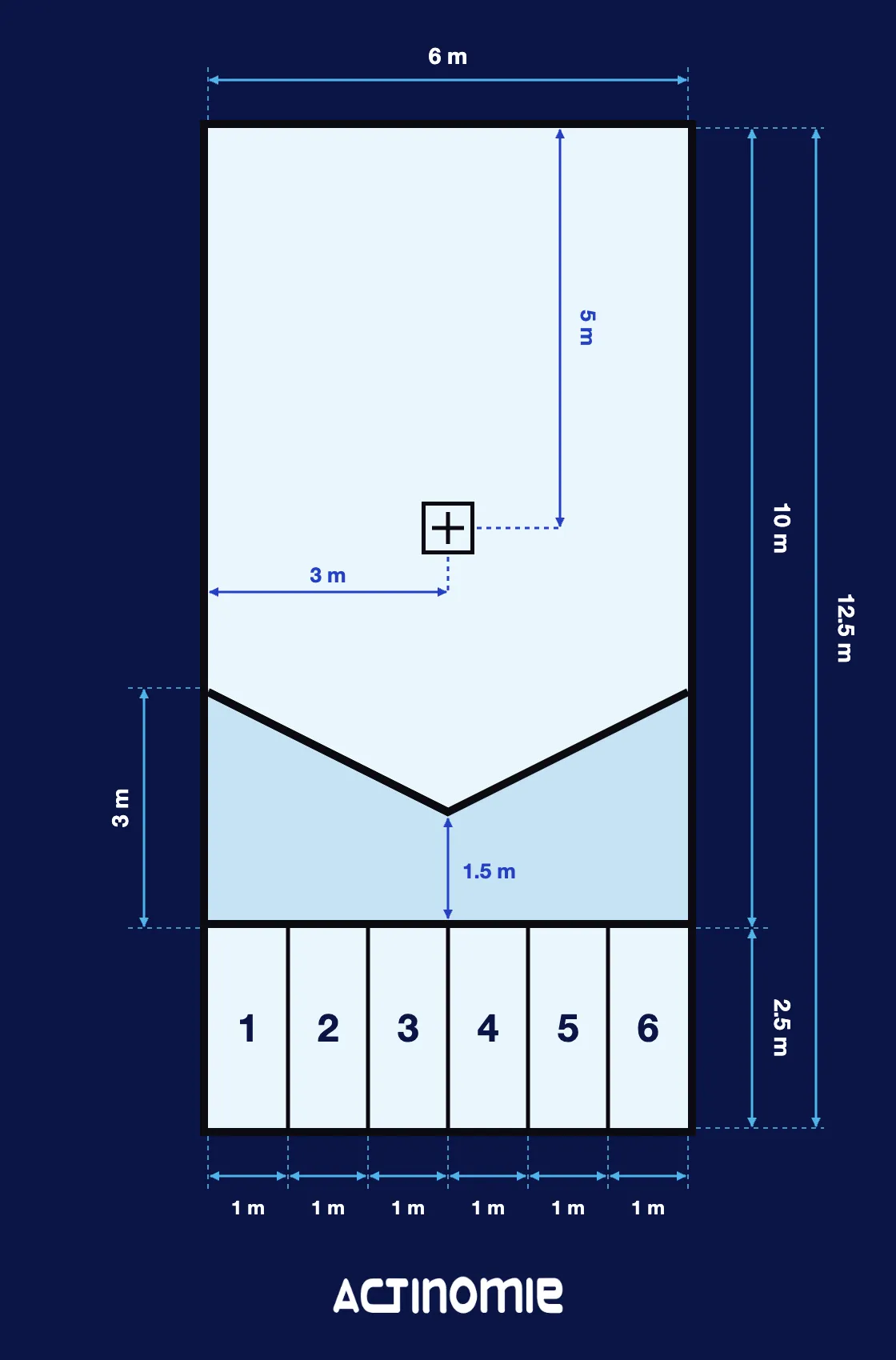
Official boccia court layout with dimensions: 12.5 × 6 m, six throwing boxes, V line and cross
2.5 × 1 m

Six throwing boxes

Each box measures 2.5 m × 1 m. The player, their balls and equipment must stay fully inside it at the moment of release, without touching the lines.
10 m

The field of play

10 metres long and 6 metres wide, from the throwing line to the back of the court. A ball that touches or crosses a boundary line is out.
V

The V line

It sits 3 m from the throwing line at the sides and 1.5 m at its point. The jack must fully cross it to be valid.
+

The cross

In the centre of the field of play, 5 m from the front line and 3 m from the sides. The jack is placed there when it goes out during an end, and for a tie-break.
35 cm

The target box

A 35 cm × 35 cm square around the cross. It is the target for penalty balls.
2 widths

Two line widths

Wide tape, 4 to 7 cm, for the boundary, the throwing line and the V. Narrow tape, 1.9 to 2.6 cm, for the box dividers, the cross and the target box.
Boccia court tape
The official court measures 12.5 m × 6 m, throwing boxes included. To discover the game, a smaller court is fine.
One end, step by step

Throw. Get closer.
Go again.

An end is over when both sides have played all their balls. A coin toss decides who plays red and who plays blue.
01

The jack

Red throws the jack in odd ends, blue in even ends. The jack must stop beyond the V, inside the field of play. If not, it passes to the opponent.
02

The first ball

The player who threw the jack plays the first coloured ball. The opponent then plays their first ball.
03

Furthest plays

The side that does not have the closest ball always plays next. It can get closer, or knock the opponent’s ball away.
04

Down to the last ball

When one side has no balls left, the other plays all its remaining balls. The referee then counts the points.

Balls at equal distance

If the two closest balls are the same distance from the jack, the side that played last plays again, then the sides alternate.

Jack knocked out during an end

It goes back on the cross, or just in front if a ball is already there. The end goes on.

Time counts

Each side has a time limit per end, from 3 min 30 to 7 min depending on the event. Throwing the jack is included.
Scoring

Count.
No arguments.

After each end, only one side scores, unless there is an exact tie. The total over all ends decides the winner.
1 point
The rule

1 point per winning ball

The side with the ball closest to the jack scores 1 point for each of its balls closer than the opponent’s best ball.
2 – 0
An example

Red scores 2 points

Two red balls are closer to the jack than the best blue ball. Red scores 2 points, blue scores nothing in this end.
+1 end
Level on points

The tie-break

The jack is placed on the cross. The winner of this extra end wins the match, and its points are not added to the score.
35 cm
After a fault

The penalty ball

Played after the end, towards the target box, it scores 1 point if it stops inside without touching the line.
Events and classes

Alone, in pairs
or in teams.

In competition, players compete in four classes, BC1 to BC4, according to their functional classification. Each class has its own rules on assistance.
Individual

6 balls per player

4 ends. BC1, BC2, BC3 and BC4 events, men and women.
Pairs

3 balls per player

4 ends. BC3 and BC4 pairs, made up of one man and one woman.
Team

2 balls per player

6 ends. Three BC1 and BC2 players, including at least one man, one woman and one BC1 player.
BC1

With a sport assistant

The player throws by hand or kicks. An assistant may steady the wheelchair or pass the ball, when the player asks.
BC2

No assistance

The player throws by hand, with no sport assistant on court.
BC3

With a ramp

The player cannot throw. They play boccia with a ramp, directing their ramp operator, who never looks at the field of play.
BC4

By hand or by foot

The player throws by hand with no assistant. If they kick the ball, a sport assistant may help.
Equipment

Compliant.
Checked before every match.

In competition, balls and equipment are checked in the call room. Non-compliant equipment is penalised.
13
Balls

275 g, 270 mm

Weight 275 g ± 12 g, circumference 270 mm ± 8 mm. Balls must come from a licensed manufacturer and carry the official World Boccia licence logo.
Choose your balls
2.5 m
The ramp

No bigger than the box

Laid on its side with extensions fully out, it must fit within 2.5 m × 1 m. No sights, lasers, spirit levels or brakes are allowed.
Boccia ramps
BC3
The pointer

In contact with the player

Head pointer or hand pointer: any length is allowed, but it must touch both the player and the ball at release. It cannot be fixed to the wheelchair or the ramp.
Pointers
Faults

The mistakes
that cost you.

The referee has five penalties, from removing a ball to disqualification. Here are the most common.
01

Ball removed

Throwing before the referee signals your colour, playing a coloured ball before the jack, forgetting the ramp swing in BC3.
02

Penalty ball

Entering the field of play without being invited, preparing your shot during the opponent’s time, delaying the match.
03

Removal and penalty

Releasing while touching a line or outside your box, ramp over the throwing line, no buttock on the seat.
04

Cards

Yellow card for a non-compliant ball or piece of equipment. Two yellow cards lose the match. Red card for unsporting behaviour.
During an end, players, assistants and coach do not communicate, except for a specific request to the assistant and to cheer after a shot.
FAQ

Your questions,
our answers.

What we are asked most often about the rules of boccia.

Can you play outdoors?

The rules call for an indoor court with a smooth floor. To play outside, on grass or sand, choose balls designed for outdoor use, such as our Lawn Boccia set.

How many players per game?

Two sides of 1 to 3 players. The 6 balls of each colour are shared between the side’s players: 6 in individual, 3 each in pairs, 2 each in teams.

Are my balls valid for competition?

They must carry the World Boccia licence logo and meet the required weight and circumference. Our product pages state which ranges are approved.

How do you measure a close call?

With a tape measure or a referee’s callipers, from the jack to each ball. Our referee tools include the tape measure, the callipers and the referee paddle.

What do you need to get started?

A set of 13 balls is all you need: 6 red, 6 blue and 1 jack. Add a roll of tape to mark the throwing line and a tape measure to settle close calls.

How is it different from bowls?

You play seated, on a marked indoor court, with leather or soft balls that barely bounce. Depending on their hardness, balls roll, slide or stop dead.
Ready to play?

Let’s equip
your first game.

Club, school, care facility or player: tell us who plays and where.
We will advise you on the right balls, ramp and accessories.
Write to us
Sport has no borders.     Neither does Actinomie.
Copyright © 2026 Actinomie | All rights reserved | Siren : 891 566 085

envelopecartlaptopgift linkedin facebook pinterest youtube rss twitter instagram facebook-blank rss-blank linkedin-blank pinterest youtube twitter instagram