0
0,00 € 0 items

No products in the basket.

Assembly guide · Wheelchairs

Multisport wheelchair.

Your wheelchair arrives largely assembled. Seven steps are all it takes to get it court-ready, followed by a few adjustments to suit each athlete, from basketball to tennis and from children to adults.
This guide covers both the Adult Multisport (sizes Small to X-Large) and the Junior Multisport. Where a step differs, we point it out.
Junior Multisport wheelchair with a silver frame and Adult Multisport wheelchair with a red frame, assembled, with their black protective bumpers
Before you start

What’s in the box.

• 1 pre-assembled frame
• 2 complete rear wheels
• 1 removable protective bumper
• 1 set of straps: feet, ankles, knees and hips
• 1 tool kit
The package weighs about 20 kg and measures about 77 × 71 × 69 cm. Leave yourself some floor space to work around the wheelchair.

Three rules for a stress-free assembly

1. Always work on an empty wheelchair. Nobody sits in it during assembly, adjustment or wheel fitting.
2. Tighten firmly, without forcing. The bolts must be properly tight, but avoid overtightening.
3. Keep the bolts for each step together. Store the hardware for each step separately so you do not mix up the long and short bolts.
Step by step

Assembly in 7 steps.

Watch the full assembly video

1

The protective bumper

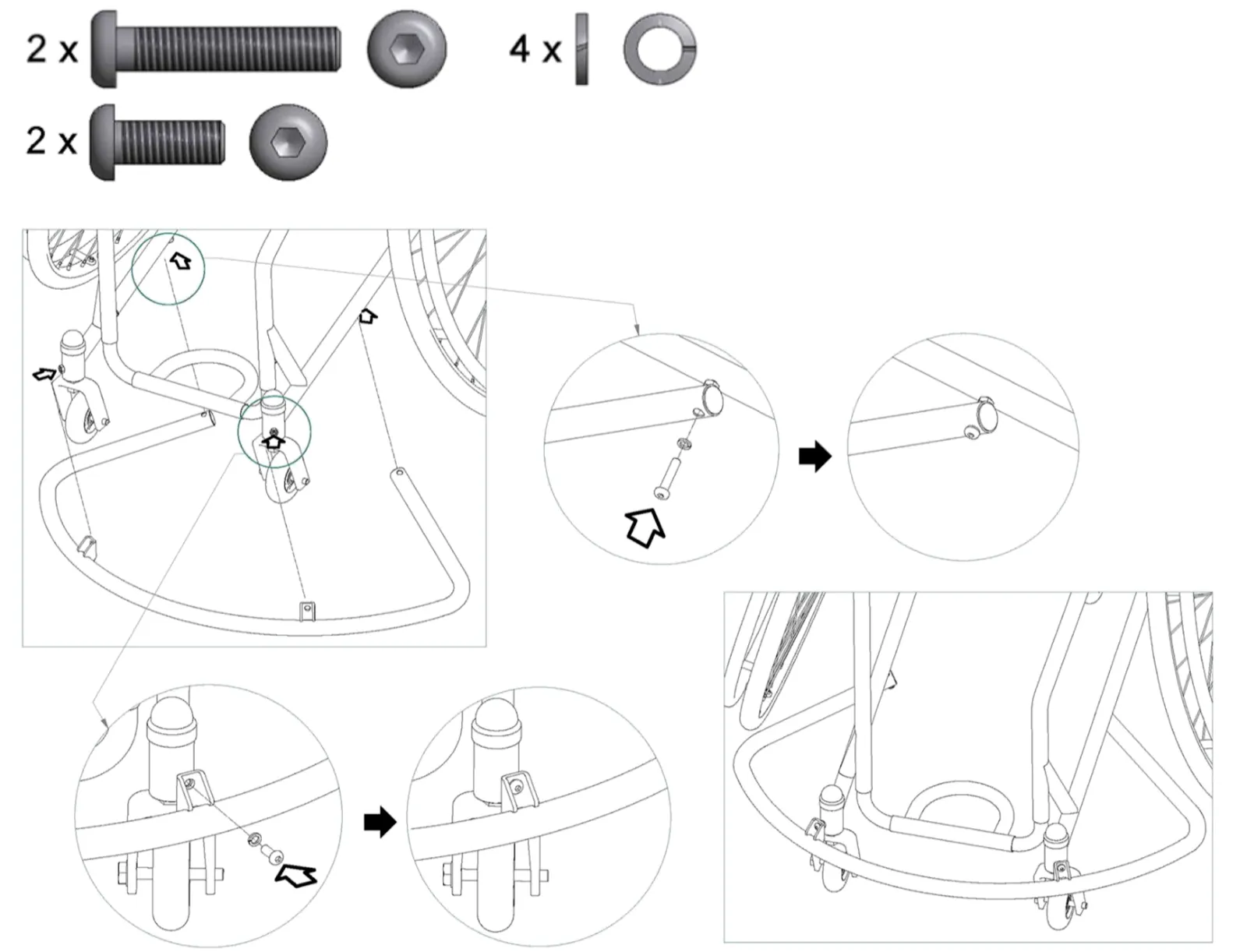
Parts: 2 long bolts, 2 short bolts, 4 washers.
Position the bumper under the front of the wheelchair. Fix it at the rear with the long bolts and at the front with the short bolts, with a washer under each bolt head. Tighten all 4 bolts.
The bumper protects the feet and the wheelchair from impacts, in basketball for example. For tennis, badminton or dance, you can leave it off.
Step 1: diagram showing how to fix the protective bumper under the front of the Multisport wheelchair, 2 long bolts at the rear, 2 short bolts at the front and 4 washers

2

The backrest tubes and their height

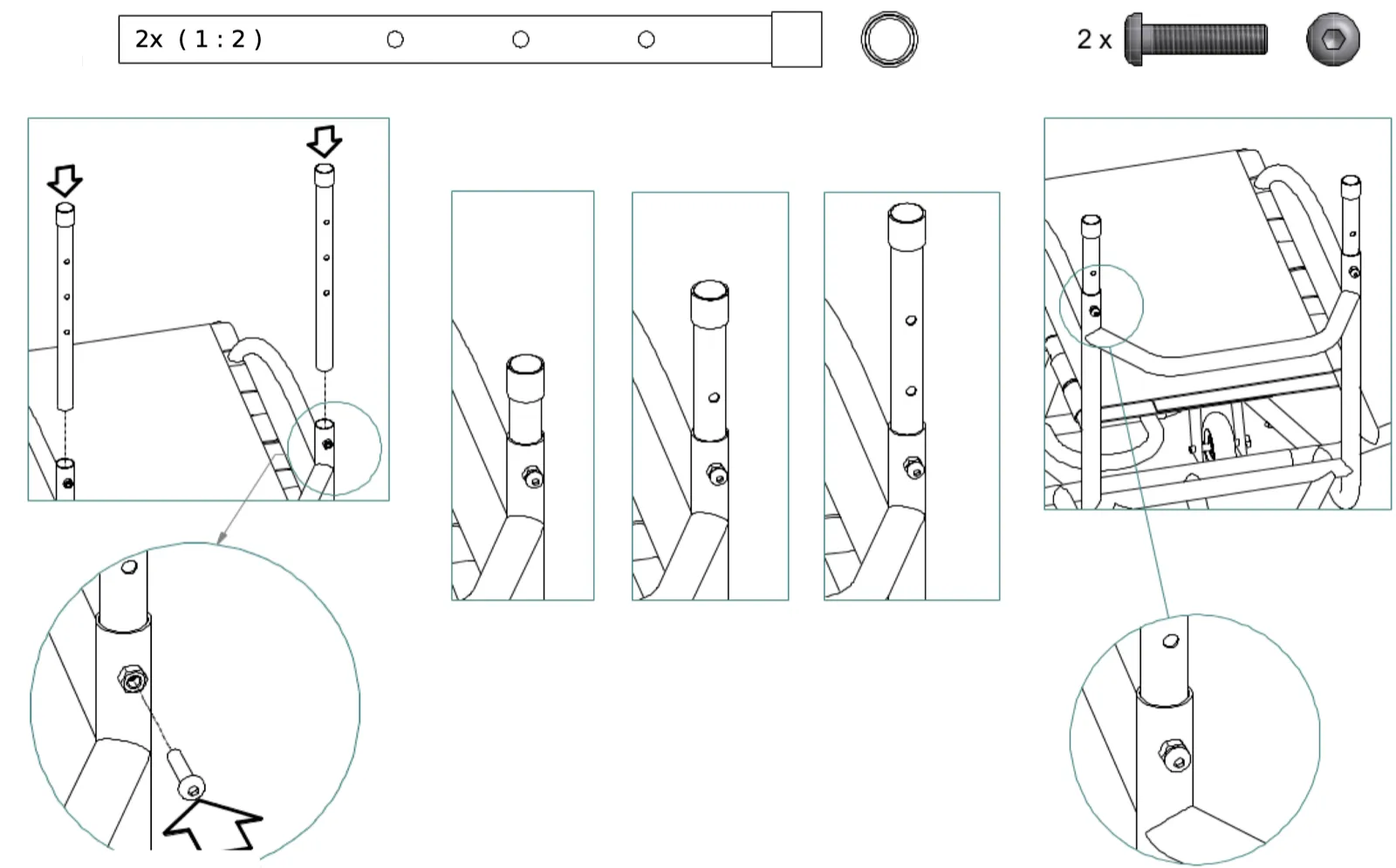
Parts: 2 backrest tubes, with their hardware.
Slide a backrest tube into each rear upright of the frame. Choose one of the three heights (low, medium or high) by lining up the hole in the tube with the hole in the upright, then fix each tube with its bolt and nut.
Backrest height (from the seat to the top of the backrest, without cushion)
Adult: 25, 30 or 35 cm
Junior: 25, 27.5 or 30 cm
Step 2: diagram of the backrest tubes slid into the rear uprights of the Multisport wheelchair, fixed with a bolt and nut, and the three backrest heights, low, medium and high

3

The backrest straps

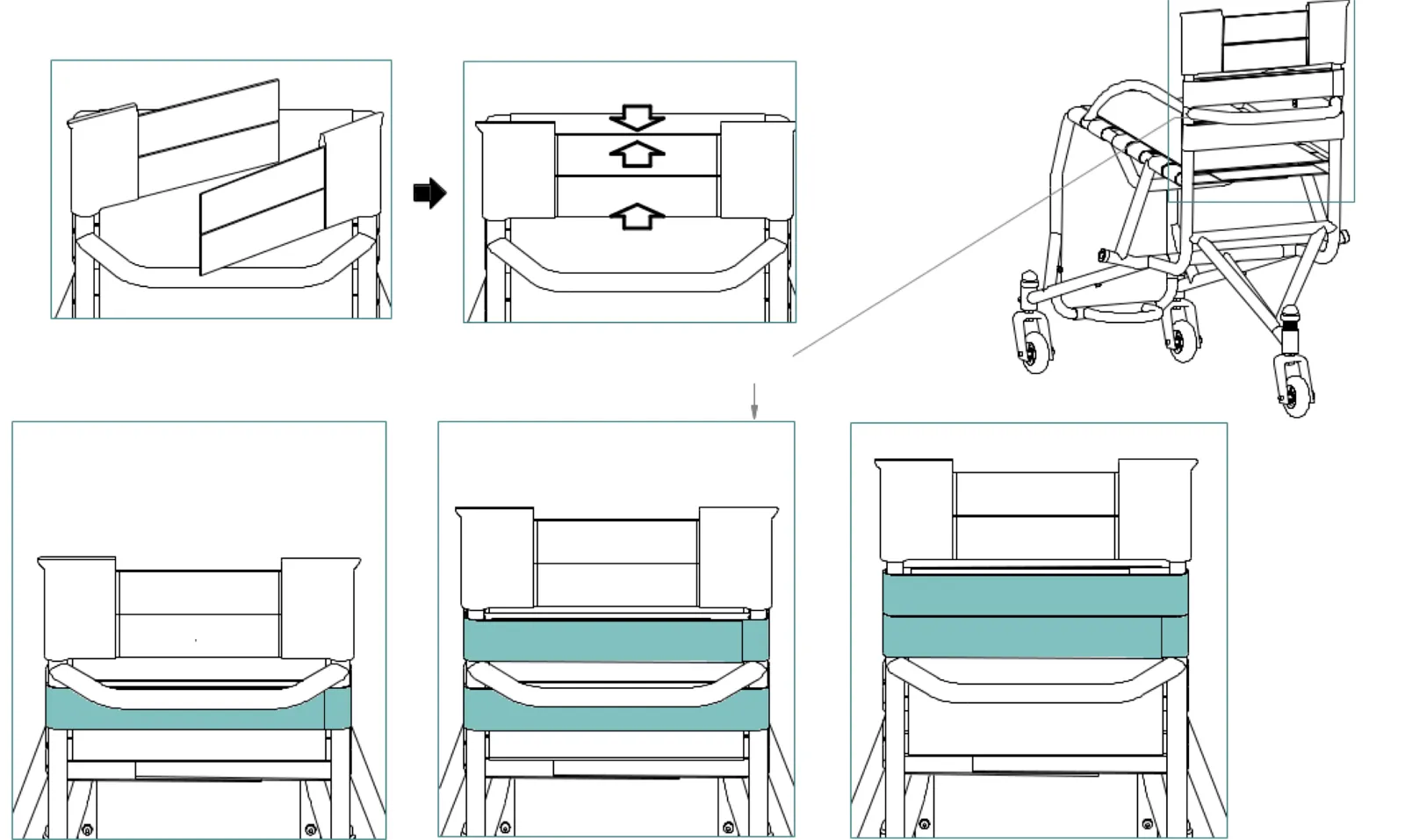
Adjust the backrest tension with the Velcro straps, then press the straps firmly together.
Their position depends on the height chosen in step 2:
• low backrest: one strap below the cross tube
• medium backrest: one strap below the cross tube and one above
• high backrest: two straps above the cross tube
Good to know: the backrest tension changes the seat depth.
Step 3: diagram of the Velcro backrest straps of the Multisport wheelchair and their position relative to the cross tube for a low, medium or high backrest

4

The backrest panel and the protective padding

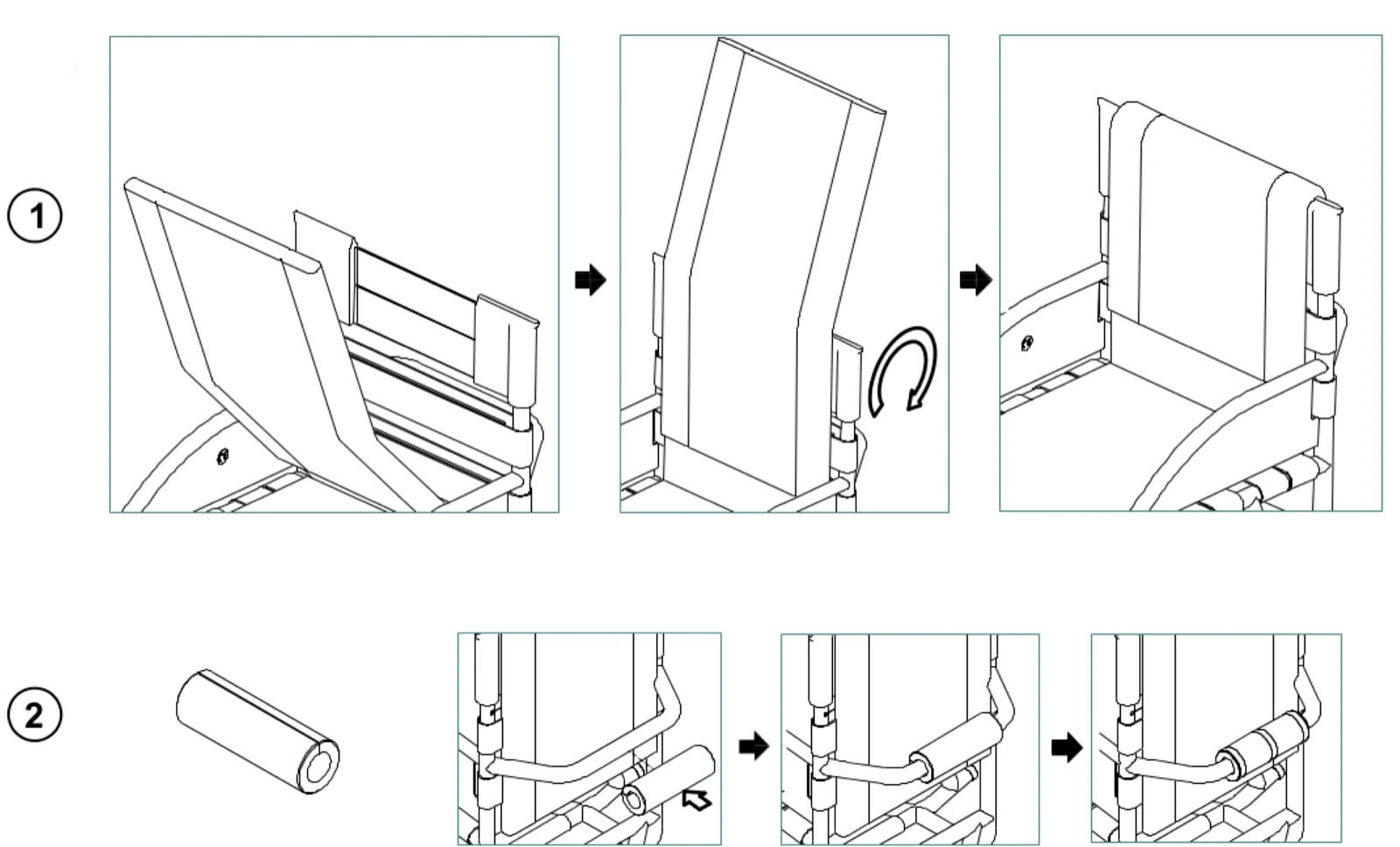
The backrest panel
1. Fix the bottom of the panel to the back of the seat with the Velcro strips.
2. Fix the panel to the front of the backrest straps.
3. Fold it over the top of the straps and fix it at the back.
The protective padding
1. Slide the foam padding onto the rear cross tube.
2. Centre it on the cross tube.
3. Hold it in place with adhesive tape.
Step 4: diagram showing the backrest panel fixed with Velcro strips and the foam padding centred on the rear cross tube of the Multisport wheelchair

5

The footrest

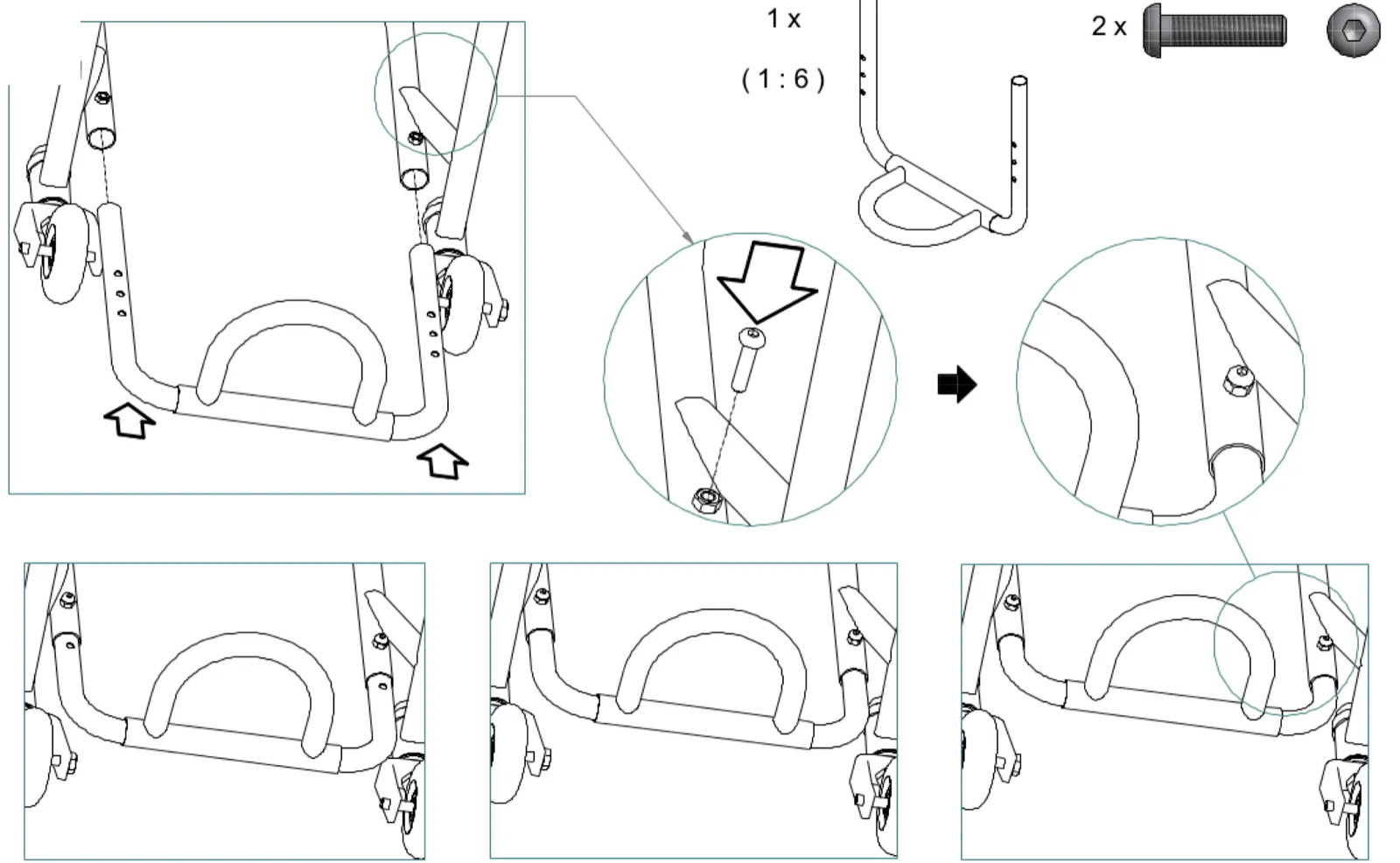
Adult Multisport. Insert the two footrest tubes into the frame from underneath. Choose one of the three heights by lining up the holes, then fix each side with its bolt. Footrest height (from the back of the knee to the sole of the foot): 45, 47.5 or 50 cm.
Step 5: diagram of the Adult Multisport wheelchair footrest inserted into the frame from underneath, fixed with one bolt on each side, in the low, medium or high position
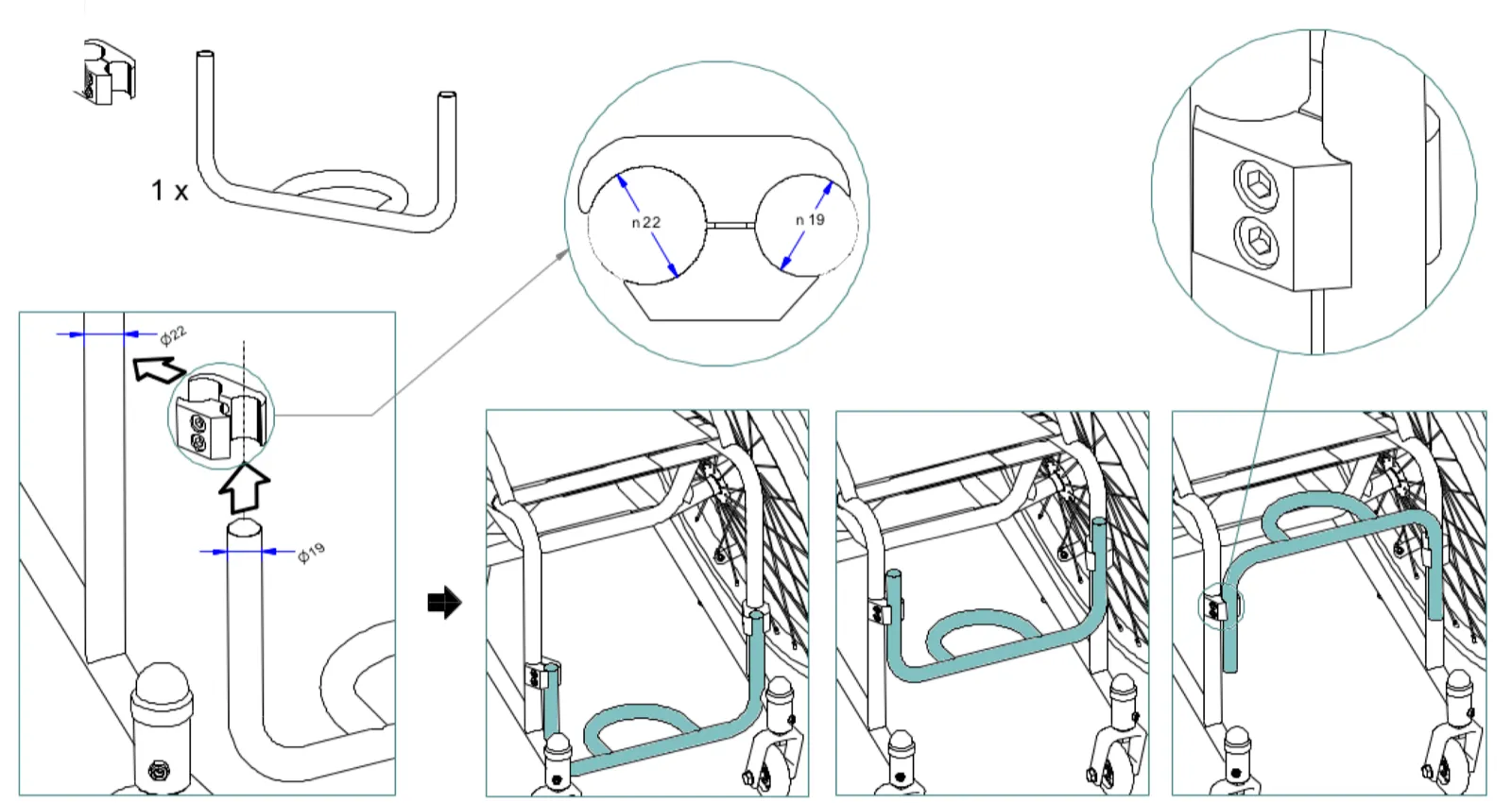
Junior Multisport. The footrest is fixed to the frame with the two clamps supplied. Each clamp has two bores: the larger one (Ø 22 mm) takes the frame tube and the smaller one (Ø 19 mm) the footrest tube. Check this orientation before tightening. Set the clamps at the height you need, from 13 to 42.5 cm, then tighten.
Step 5: diagram of the Junior Multisport wheelchair footrest fixed to the frame with two double-bore clamps of 22 and 19 mm, in the low, medium or high position

6

The anti-tip castor

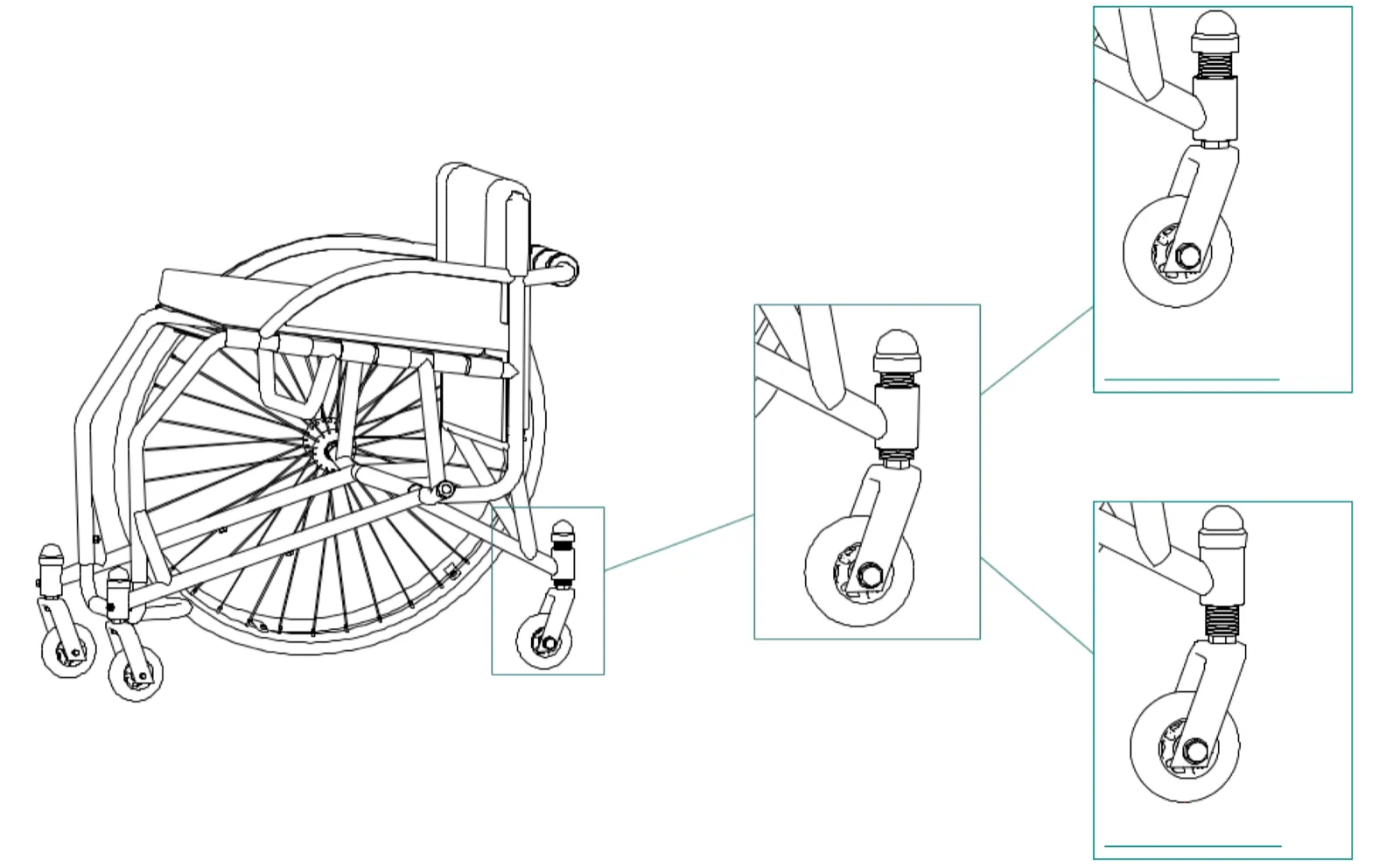
The rear castor stops the wheelchair from tipping backwards. Its height can be set from 0 to 20 mm above the ground by positioning the washers around the castor axle:
• high position: all washers above the axle.
• medium position: washers split above and below.
• low position: all washers below the axle.
With each new athlete or new seating position, stability changes: adjust the anti-tip castor accordingly.
Step 6: diagram of the anti-tip castor at the rear of the Multisport wheelchair, with the washers placed above, on either side of or below the castor housing

7

The rear wheels

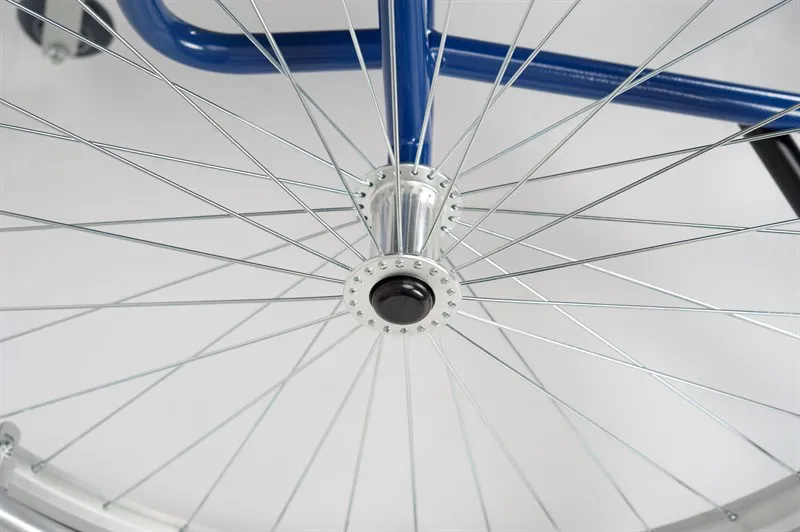
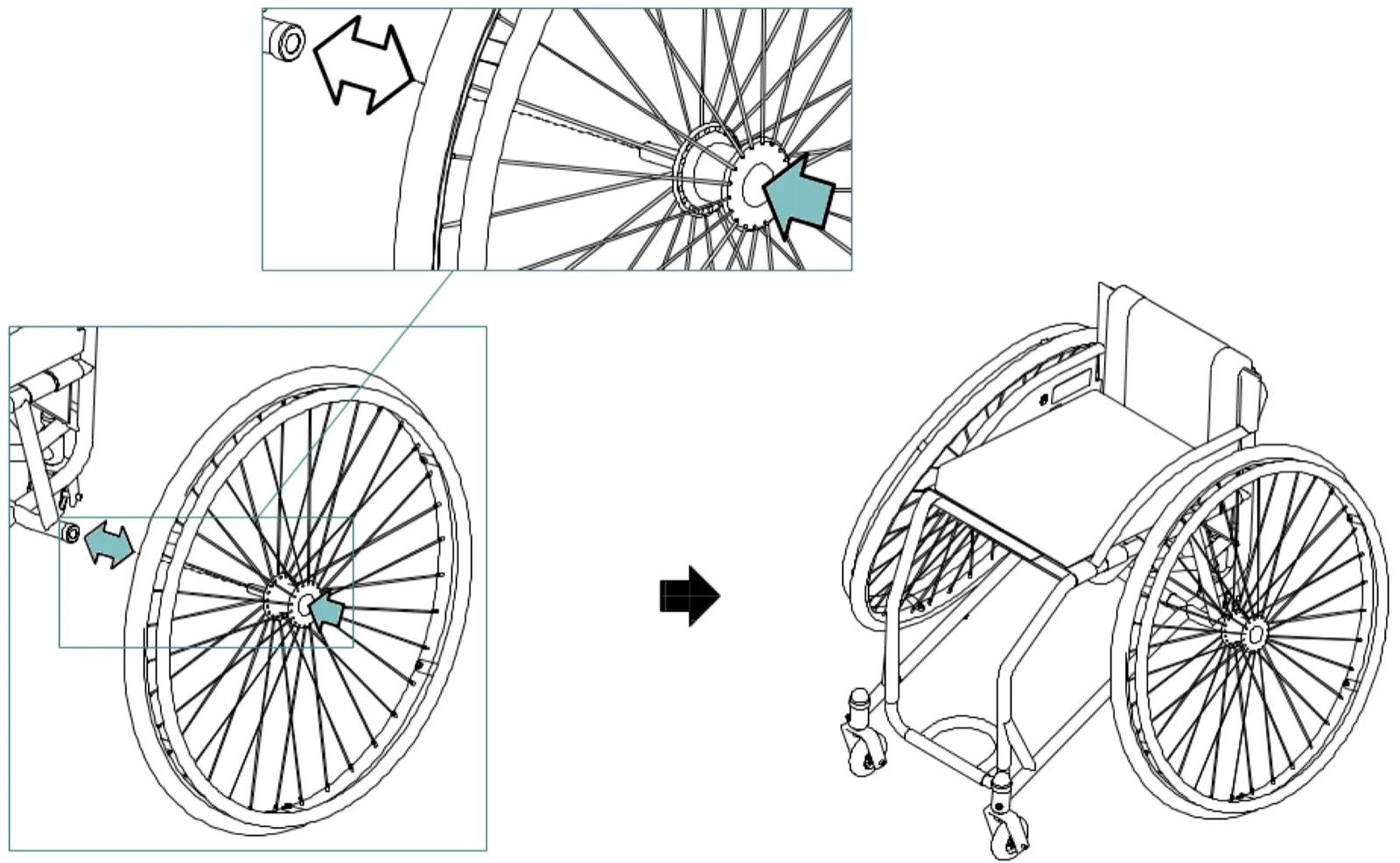
1. Press and hold the button in the centre of the hub to release the quick-release axle.
2. Slide the axle into its housing on the frame.
3. Release the button.
4. Pull on the wheel to check that it is locked in place.
Make sure the axle is clean before sliding it in. Carry out this check every time you refit the wheels, always on an empty wheelchair.
Rear wheel hub of the Multisport wheelchair with the quick-release axle button in the centreStep 7: diagram showing how to fit a rear wheel on the Multisport wheelchair, with the hub button pressed and the axle slid into its housing on the frameVideo: adjusting the quick-release axle if there is play or the axle will not click in
Adjustments

One wheelchair, many athletes.

The Multisport is designed to move from one player to the next. Go through these adjustments every time the user changes.

Seat depth

Adult: 35 or 40 cm (for 35 cm, fold the cushion under the seat)
Junior: 30 cm

Backrest height

Adult: 25, 30 or 35 cm
Junior: 25, 27.5 or 30 cm

Footrest height

Adult: 45, 47.5 or 50 cm
Junior: from 13 to 42.5 cm

Anti-tip castor

Adult: 0 to 20 mm above the ground
Junior: 0 to 20 mm above the ground

Backrest and seat tension

Adult: Velcro straps
Junior: Velcro straps

Maximum load

Adult: 100 kg
Junior: 75 kg
The 5 cm cushion can be cut down to the length of the seat.
The 4 straps (hips, knees, feet, ankles) keep the body stable during play. They matter as much for safety as for performance.
Feet not reaching the Adult footrest, even in the high position? Talk to us: a clamp fitting, as on the Junior, allows a higher, made-to-measure position.
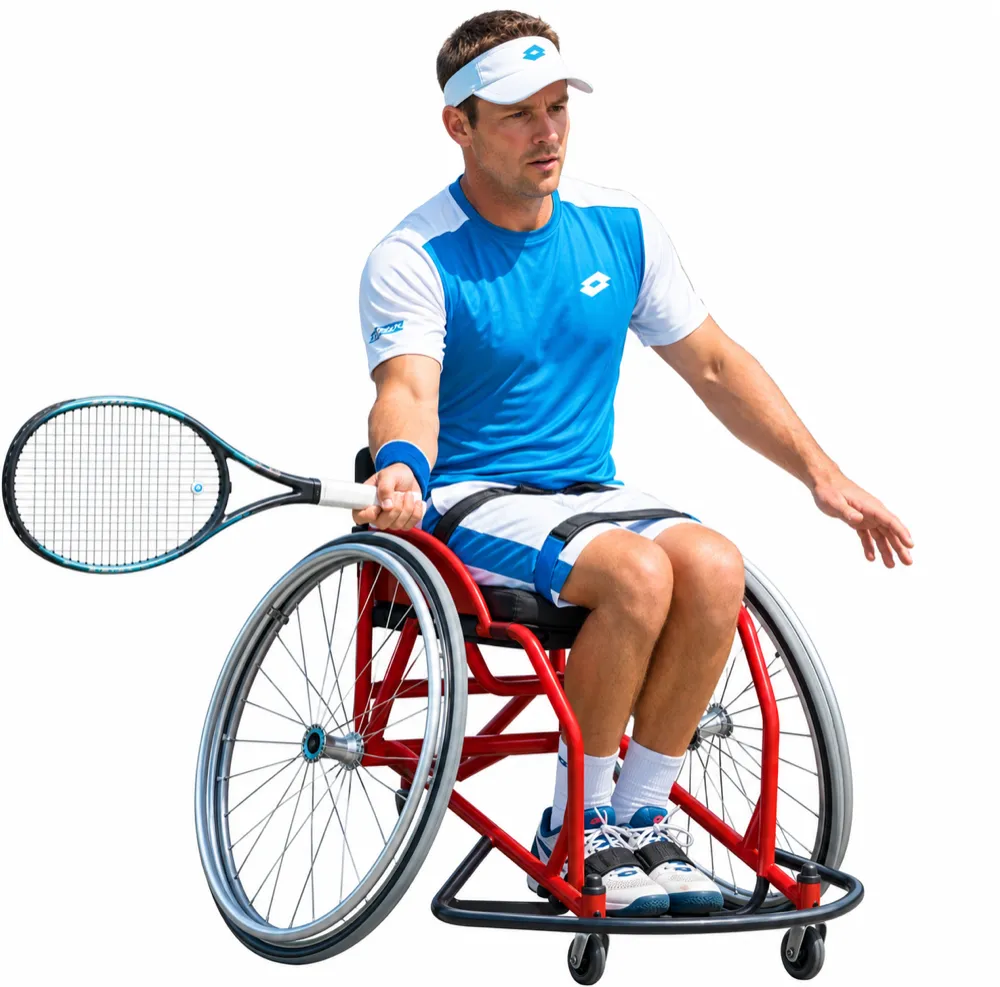
Tennis player in a red-framed Multisport wheelchair, thigh strap fastened, playing a forehand
Before your first session

The 12 checks.

• The front castors spin freely.
• The forks swivel freely on their axle.
• The footrest bolts are properly tightened.
• The backrest bolts are properly tightened.
• The backrest straps are firmly fastened.
• The seat straps are firmly fastened.
• The rear wheel axles are locked onto the frame.
• The rear wheels spin freely.
• The tyres are inflated to the pressure shown on the sidewall, without over-inflating.
• The protective padding is fixed on the backrest cross tube.
• The cushion sits correctly on the seat.
• The athlete’s straps are in place.
After that, check that the wheelchair works properly before every use.
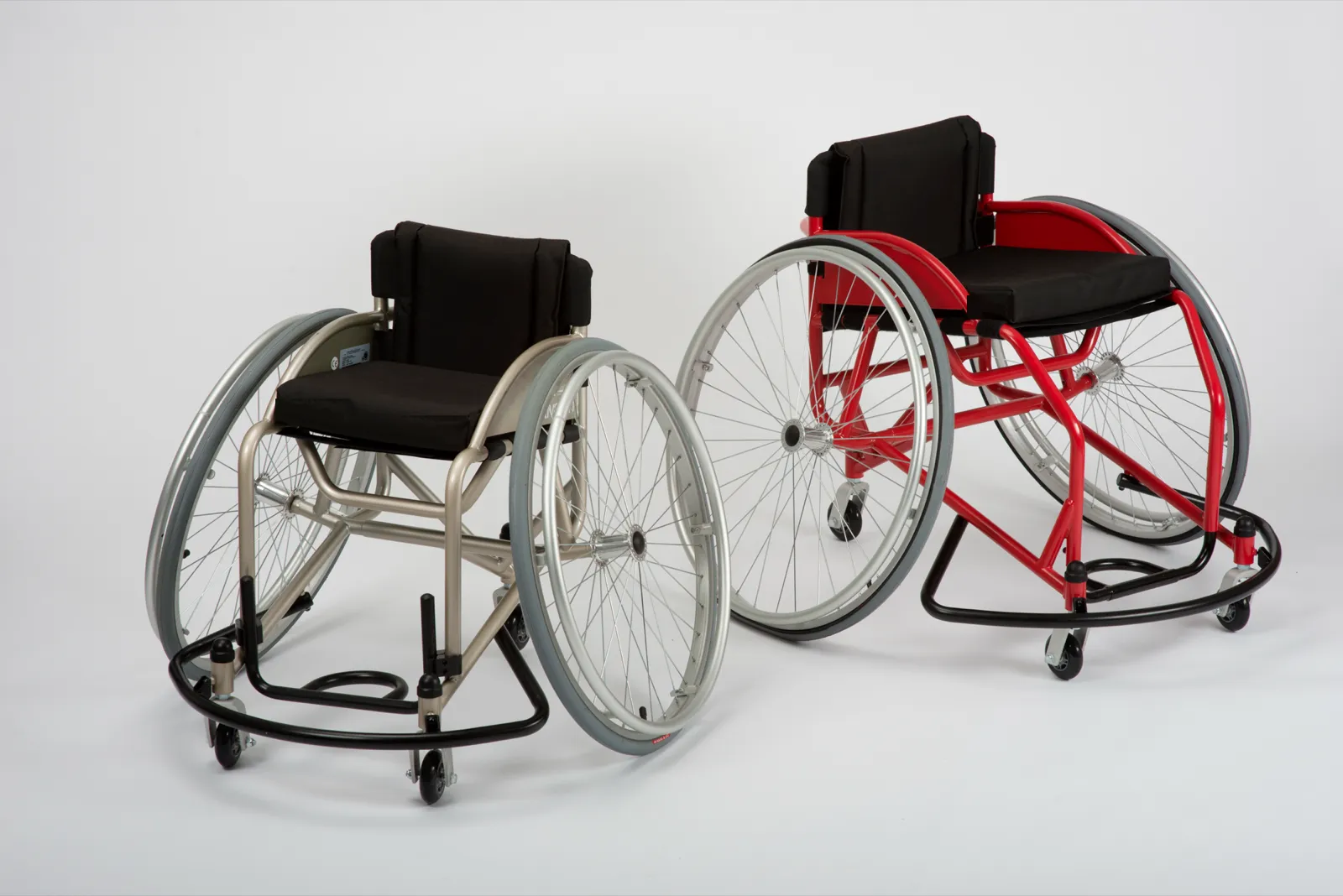
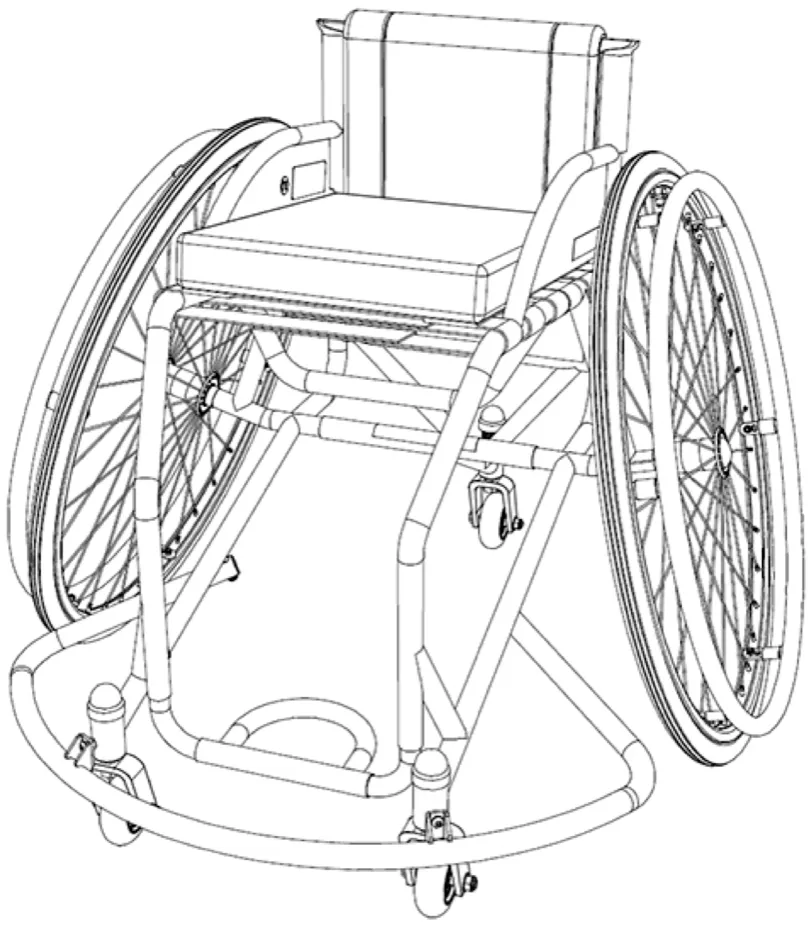
Diagram of the fully assembled Multisport wheelchair, with its backrest, cushion, rear wheels and protective bumper
Safety and care

Built to last, season after season.

Using it safely

• This Multisport wheelchair is designed for sports courts and play areas. It is not an everyday wheelchair.
• It is not designed for sports with direct impacts, such as wheelchair rugby.
• One person at a time, with no load carried.
• Keep your hands out of the spokes while the wheels are turning. If needed, we offer spoke guards to fit these wheels.
• Never lean on the footrest during a transfer. Do not stand on it, nor on the anti-tip castor.
• Check your skin before and during activity, and relieve pressure regularly. If you notice any skin damage, stop until it has healed.
• Worn or damaged seat or backrest upholstery: stop using the wheelchair until it has been replaced.
• Do not smoke in the wheelchair.
• No salt water. On sand, check and lubricate the bearings regularly.
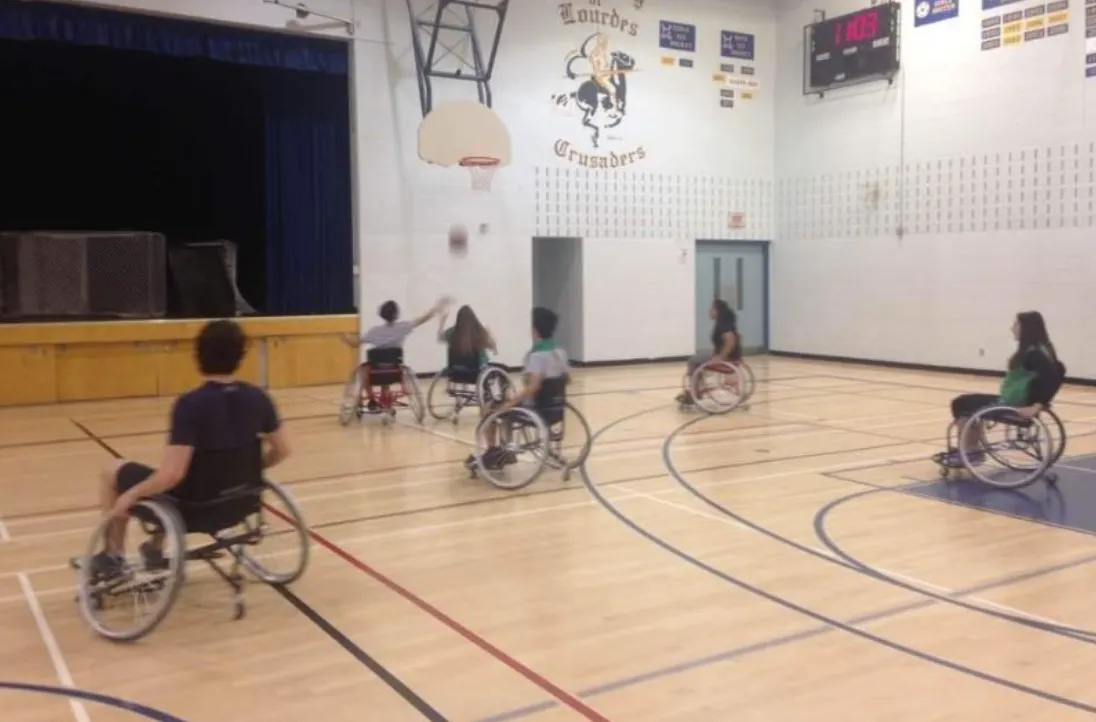
Young athletes in Multisport wheelchairs during a wheelchair basketball session in a sports hall

Transport and storage

• Remove the rear wheels for transport. Without them, the frame rolls on its three castors.
• Carry the wheelchair by the frame, never by the upholstery. Do not drop it.
• Wipe the wheels and axles before storing, and keep the wheelchair somewhere dry.
• No heavy rain, no hose and no pressure washer. If the wheelchair gets wet, dry it as soon as possible.
• Touch up any scratch in the paint straight away to prevent corrosion.

Maintenance

Every day of use: tyre pressure. Repair any puncture straight away.
Every month: condition of the cushion and upholstery (tears, seams, foam). Spoke tension. Quick-release axle locking. Castor axles and fork stems. Bolts on the footrest, backrest tubes and bumper.
As soon as it gets dirty: wash the upholstery and cushion cover, dry completely before refitting, never in the sun.
If a wheel does not turn smoothly: lubricate or replace the bearings.
Actinomie tip: for sports with impacts, take a quick look at the 4 bumper bolts before every session.

A problem during play?

The wheelchair pulls to one side

Same pressure in both tyres. Both front castors touch the ground at the same time. Fork and anti-tip castor adjustment.

It turns too quickly

Re-tension the backrest upholstery, change the position of the feet.

It loses contact with the ground

Tyre pressure, both front castors on the ground. Raise the anti-tip castor if needed.

It feels sluggish when turning

Tyre pressure. Forks and fork stem (loosen very slightly if too tight). Wheels turning freely, bearings, clean hub and axle.

The castors flutter

Fork adjustment, bearings, anti-tip castor height.

It squeaks or has play

Forks and bearings. Spokes, push rims and all hardware to retighten.

The seat sags

Refasten the seat straps as tightly as possible.

A wheel has play or will not lock

The length of the quick-release axle is easy to adjust. Follow the video step by step.
Watch the adjustment video
Spare parts: contact us with the wheelchair’s serial number, found on the inside of the seat.
Shall we talk?

A new athlete, a new sport?

Adjusting the wheelchair for a growing child, equipping a club with players of all builds, fitting spoke guards or choosing equipment for your sessions: let’s talk about your project.
Contact us
Sport has no borders. Neither does Actinomie.

Copyright © 2026 Actinomie | All rights reserved | Siren : 891 566 085

envelopecartlaptopgift linkedin facebook pinterest youtube rss twitter instagram facebook-blank rss-blank linkedin-blank pinterest youtube twitter instagram